

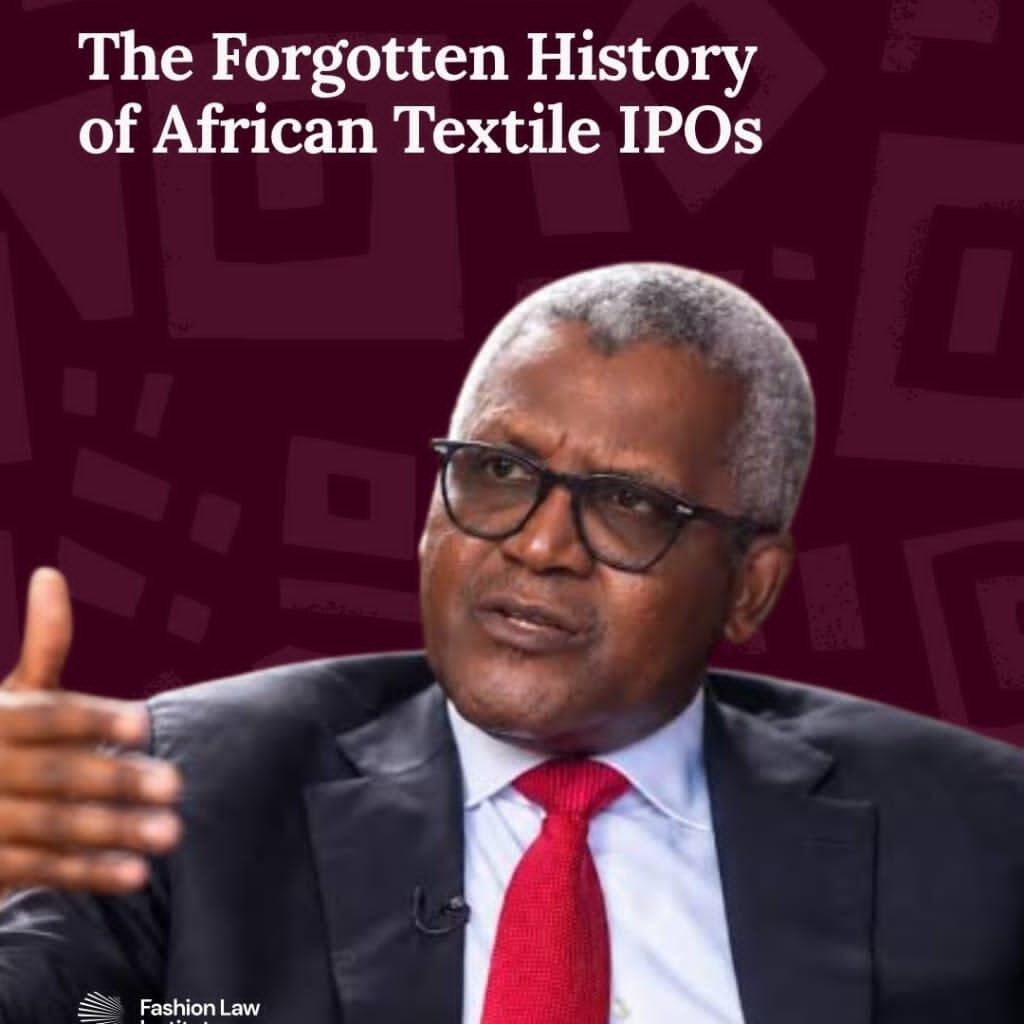

Everyone is talking about IPOs right now. Aliko Dangote, Africa’s richest man, just launched the continent’s biggest-ever share sale on September 14, 2026, taking his oil refinery public in a “people’s IPO” targeting $2.1 billion, letting ordinary Nigerians buy in for as little as $4 a share. Global luxury conglomerates like LVMH have long traded publicly. Direct-to-consumer fashion brands and fashion tech platforms keep chasing the same milestone. Going public is having a genuine moment, in Nigeria and globally.
But while everyone celebrates these modern listings, Africa has a deeply rooted, industrial history with public markets that most of today’s conversation has completely forgotten, one built not on oil or luxury branding, but on textiles.
Africa’s public market presence in fashion didn’t start with sleek, modern brands. It started with massive, industrial textile mills, the companies that actually clothed nations, employed hundreds of thousands, and once traded on stock exchanges across the continent, decades before Dangote ever rang an opening bell.
The Survivors: African Textile Companies Still on the Market
While most modern fashion brands remain privately held, a small number of legacy textile manufacturers made the leap to public markets and, remarkably, some are still there.
Uniwax (Côte d’Ivoire), listed on the BRVM, the regional exchange serving eight West African countries, under the ticker UNXC, remains one of the last authentic wax fabric producers still operating in West Africa, founded in the late 1960s in Abidjan’s Yopougon industrial zone. And its story just got genuinely more interesting. In early 2026, Compagnie Ivoirienne de Coton acquired a majority stake in Uniwax, a deal specifically aimed at vertically integrating the company, linking Côte d’Ivoire’s raw cotton production directly to Uniwax’s finished textile manufacturing. The results have been striking, Uniwax’s stock gained 241 percent on the BRVM in 2025, with net profit reaching roughly 8.1 billion CFA francs by the end of the third quarter.
Rex Trueform Group (South Africa), listed on the Johannesburg Stock Exchange since 1948, began as a clothing manufacturer and evolved over decades into a major retail and apparel investment holding company, a genuine, nearly eight-decade public market survivor.
Nigeria’s Great Delisting: When the Boards Went Silent
Nigeria’s own textile history is where this story turns genuinely painful. During the industry’s peak, roughly 1970 to 1987, Nigeria’s textile sector employed over 350,000 workers directly, ranking second only to the federal government itself as the country’s largest employer. By the mid-1980s, Nigeria was home to 175 textile mills, concentrated across Aba, Asaba, Funtua, Gusau, Kaduna, Kano, Port Harcourt, and Lagos, with Kaduna earning the nickname “Textile City” for hosting three of the industry’s largest mills.
Dozens of these mills traded publicly on the Nigerian Stock Exchange, now the NGX, during that peak, and macroeconomic collapse forced them off the boards one after another. Nigerian Textile Mills Plc went first, delisted voluntarily in 2008. Aba Textile Mills Plc and Asaba Textile Mills Plc followed in 2009, both delisted by regulatory action after operational collapse, Asaba’s ending in outright bankruptcy and a full halt in production. United Nigeria Textile Plc, one of the industry’s earliest and most significant players, founded in 1962, held on longer than most before its own voluntary delisting in 2011.
Aswani deserves its own telling, because it may be the most vivid story of them all. Trading publicly under the registered names Aswani Industries Plc and Aswani Textile Industries Plc, the company was founded in the 1970s and built its mill in Lagos’s Isolo Industrial Estate. The factory grew so significant that an entire market, Aswani Market, sprang up directly outside its gates, traders gathering weekly to buy lace, Ankara, and uniform fabrics straight off the company’s own trucks. The market outlived the mill. Like Afprint and United Nigeria Textile Limited, Aswani was hit hard by the mid-1990s import boom and chronic local power failures, and as operations collapsed, the company stopped trading on the main board entirely. Its parent structure survived only by transmuting into an entirely different business, distributing consumer products through Chellarams Plc, a Nigerian trading and distribution conglomerate with no connection to textile manufacturing at all.
It is a genuinely fitting symbol for the whole industry’s collapse, a company once so central to Lagos’s textile trade that an entire market bears its name, reduced to a footnote inside someone else’s distribution business, while the market that grew from its factory gates continues trading to this day, long after the mill itself went silent.
Beyond these named delistings, the wider collapse was staggering. Afprint Nigeria and Enpee Industries, once among the sector’s most recognisable names, abandoned textiles entirely rather than simply delisting, Afprint pivoted into oil manufacturing and the car business, while Enpee became a packaging company. Within just six years of the broader collapse, over 50 Nigerian textile companies shut down altogether, and roughly 80,000 workers lost their jobs.
Why Nigeria’s Textile Giants Actually Fell
It’s worth being precise here, these companies did not fail because demand disappeared. Between 1970 and 1987, demand for Nigerian textile products had actually exceeded supply by an astonishing 91 percent. What destroyed them was structural: chronic power outages forcing factories onto costly diesel generators and destroying already-thin margins; a flood of cheap, often smuggled textile imports, increasingly from Asia, undercutting locally taxed fabric on price; and rising costs from cotton shortages and logistics that made local production financially unsustainable even before foreign competition entered the picture.
Takeaway
The current global enthusiasm for IPOs proves something worth sitting with, structural support matters every bit as much as brand popularity, arguably more. Uniwax’s 2026 turnaround, a 241 percent stock gain achieved precisely because a new owner committed to vertical integration, linking Ivorian cotton directly to finished textile production, offers a genuinely live, current illustration of what industrial policy done right can still achieve, even in a sector Nigeria’s own history suggests should be a cautionary tale rather than a growth story.
So the real question worth asking: will African fashion and textile industries ever get to see a genuine new wave of IPOs? Not just isolated survivors like Uniwax and Rex Trueform, but a real, sustained wave, African fashion houses, textile manufacturers, and creative brands going public the way Dangote’s refinery just has.
The honest answer depends entirely on whether the continent closes the same gap this piece has traced throughout, the space between creative design ambition and the robust, cost-effective, properly protected manufacturing infrastructure that public markets actually reward.
Learn more about Fashion Law Institute Africa’s research on Nigeria’s textile industrial policy and trade at thefashionlawinstitute.org.