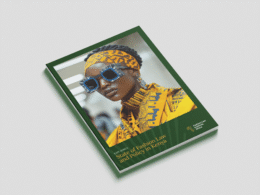



Part of the State of Fashion Law & Policy in Africa 2026 | North Africa
North Africa’s fashion sector is among the most economically significant and historically deep on the continent. Morocco and Tunisia are major garment suppliers to the European Union under proximity sourcing models, and Egypt has a substantial cotton and textile manufacturing base. The region is also home to design traditions of extraordinary richness: the Moroccan caftan and djellaba, Egyptian galabiya weaving, Tunisian chéchia felt-hat making, and Amazigh textile traditions across the Maghreb.
This chapter of the Fashion Law Institute, Africa’s annual flagship report examines fashion law in Egypt, Morocco and Tunisia. It is based on desk research by the FLI Africa team. Full country contributions from North African practitioners, including Algeria and Libya, are planned for the 2027 edition.

Egypt: Centralised IP, Persistent Counterfeiting
Egypt’s fashion IP is governed by the Law on the Protection of Intellectual Property Rights No. 82 of 2002. Since 2023, all IP registration has been centralised under the new Egyptian Authority for Intellectual Property, which replaced separate offices spread across several ministries. Copyright protects fashion designs, textile patterns and embroidery for the author’s lifetime plus 50 years.
Enforcement remains the challenge. Large informal markets such as Wekalet El Balah and Al-Ataba are significant sources of counterfeit fashion goods. Egypt’s textile heritage, including Pharaonic-inspired embroidery and Nubian fabric patterns, has no specific legal protection. Egyptian cotton is one of the world’s most valuable textile names, but its protection as an origin-based product remains underdeveloped.
Morocco: Near-Shore Manufacturing and Unprotected Heritage
Morocco is North Africa’s most developed fashion law jurisdiction. Its industrial property law (Law No. 17-97) and copyright law (Law No. 2-00) are administered through OMPIC‘s efficient, digitised registration system. Membership of the Madrid and Hague Systems gives Moroccan brands affordable routes to international protection. The EU Association Agreement has made Tangier and Casablanca major near-shore manufacturing hubs for European brands.
Two gaps stand out:
- Heritage: The caftan, the djellaba, Fassi embroidery and Marrakech leather are strong candidates for geographical indication protection, but none is yet registered.
- Labour: Enforcement gaps around working hours and freedom of association have been documented in the export sector. These gaps matter more as European brands face growing supply chain due diligence obligations.
Tunisia: A Heritage Toolkit Waiting to Be Used
Tunisia protects copyright under Law No. 94-36 of 1994, trademarks under Law No. 2001-36, and industrial designs under Law No. 2001-21, with registrations handled by INNORPI.
Tunisia is one of the few African countries with a dedicated law protecting handicrafts by origin. Law No. 2007-68 on geographical indications for handicrafts offers a ready route to protecting chéchia and other artisanal traditions. Its copyright law also requires Ministry of Culture authorisation for works inspired by folklore. The legal tools exist; the challenge is putting them to use.
North Africa’s Continental Significance
As AfCFTA implementation progresses, trade between North Africa, with its manufacturing capacity and EU market access, and Sub-Saharan Africa, with its design talent and growing consumer markets, has substantial potential. Realising it will require:
- harmonised rules of origin
- mutual recognition of IP registrations across African jurisdictions
- removal of the non-tariff barriers that currently make intra-African fashion trade costlier than trade with Europe
Recommendations
The report recommends:
- registering geographical indications for Egyptian cotton and Moroccan caftan, djellaba and Fassi embroidery
- using Tunisia’s existing 2007 handicraft GI law to register chéchia
- developing cultural heritage protection frameworks in all three countries, drawing on WIPO’s GRATK Treaty
- providing legal compliance support so Moroccan and Tunisian manufacturers can meet EU supply chain due diligence requirements
- establishing fashion-specific alternative dispute resolution mechanisms
- making intra-African fashion trade under AfCFTA a dedicated research and policy priority
Download the full North Africa chapter
Frequently Asked Questions
How is fashion IP registered in Egypt?
Since 2023, all intellectual property in Egypt, including trademarks, designs and copyright, has been handled by a single body, the Egyptian Authority for Intellectual Property, established by Law No. 163 of 2023.
Can the Moroccan caftan be legally protected?
Morocco’s industrial property law provides for geographical indications, and the caftan, the djellaba and Fassi embroidery are strong candidates. However, none is yet registered, so protection currently depends on individual brands’ trademarks and designs.
Is Tunisian chéchia legally protected?
Tunisia has a dedicated law, Law No. 2007-68, protecting handicrafts through geographical indications, which provides a ready route to protecting chéchia. The report recommends that artisans and authorities actively use it.
How do EU rules affect North African garment manufacturers?
European brands face growing legal obligations to monitor labour and environmental standards in their supply chains. Moroccan and Tunisian suppliers will increasingly need to demonstrate compliance to keep European contracts.
About the Contributors
This chapter was prepared by the Fashion Law Institute, Africa team: Bernice Asein, Founder and Executive Director; Eleojo Unwuchola, Programs and Projects Lead; and Grace Efiong, Secretary.
Read other chapters of the State of Fashion Law & Policy in Africa 2026, including Nigeria, Kenya, Uganda, South Africa and the Francophone OAPI zone.