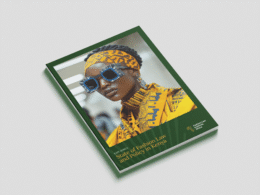



Part of the State of Fashion Law & Policy in Africa 2026 | West Africa

Nigeria’s fashion industry is one of the most vibrant and commercially significant on the continent. It stretches from the atelier-led luxury houses of Lagos to the high-volume production centres of Aba and Kano. Nigerian designers command global audiences on Instagram, TikTok and international e-commerce platforms. Yet fashion law in Nigeria has not kept pace. The legal framework is fragmented, weakly enforced and poorly understood, and in several areas it actively works against the designers it should protect.
This chapter of the Fashion Law Institute, Africa’s annual flagship report examines Nigerian fashion law across intellectual property, digital infringement, commercial and tax law, advertising, consumer protection, sustainability, cultural heritage and cross-border trade. It draws on statutory analysis, the 2025 National IP Policy and Strategy, recent case law and practitioner observation.
Copyright Protection for Fashion Designs in Nigeria
The Copyright Act 2022 automatically protects original textile designs, fashion illustrations, embroidery patterns and fabric prints, with no registration required. It also introduced border seizure powers and a digital copyright framework.
However, the report identifies a critical gap. When an artistic work is industrially applied and mass-produced, its copyright protection can be weakened or lost. The alternative is industrial design registration under the Patents and Designs Act 1970, but that law is over fifty years old and ill-suited to modern fashion. In effect, the law penalises success: designers become most exposed at the moment they scale.
Weak Enforcement Against Fashion Counterfeiting
Nigeria’s 2025 National IP Policy and Strategy described criminal penalties for IP infringement as grossly inadequate. The maximum penalty for wilful trademark counterfeiting or copyright piracy is six months’ imprisonment or a ₦100 fine. Civil litigation averages two to five years. For most fashion designers, who lack corporate legal budgets, legal redress is effectively out of reach.
Design Copying: China, Shein, AliExpress and Turkey
Nigerian designs, including Adire prints, Ankara reinterpretations and contemporary Afro-luxury aesthetics, are being copied at industrial scale. Chinese manufacturers sell the copies back into Nigerian and African markets through platforms such as Shein and AliExpress, often within weeks of a collection’s launch.
Separately, Nigerian designs are being produced in Turkey and re-imported at around a quarter of the original retail price, often at comparable quality. The report treats this as displacement rather than mere imitation. It is made worse because many designs are never formally registered.
Nigeria’s Tariff Structure and the Cost of Local Production
Nigeria’s trade policy imposes higher duties on raw materials such as cotton, fabric and textile inputs than on finished imported garments. As a result, importing finished clothing is cheaper than manufacturing it locally. This tariff inversion undermines Nigerian garment manufacturing and explains why overseas copying is so commercially damaging.
Protecting Nigerian Traditional Textiles: Adire, Aso-Oke and Akwete
Nigeria’s textile heritage is among the richest in Africa. The folklore provisions of the Copyright Act 2022 are among the most progressive on the continent. They require consent from the originating community and the Nigerian Copyright Commission before commercial use, and they require attribution of the source community.
In practice, however, there is no registry of communities and the works they own, so the consent requirement cannot operate. Not one Nigerian textile tradition has a registered Geographical Indication. The Geographical Indications Bill is still pending before the National Assembly. The report also documents how international luxury brands have drawn on African design without attribution or compensation to the originating designers or communities.
Fashion Business, Tax and Advertising Rules in Nigeria
The report identifies two significant positive developments. First, the Federal Ministry of Finance’s March 2026 Presumptive Tax Rules exempt fashion MSMEs with annual turnover below ₦12 million from companies income tax, with a simplified 1% rate above that threshold. Second, a 2025 Federal High Court ruling confirmed that ARCON’s jurisdiction, including mandatory pre-publication vetting, extends to social media advertising. That brings fashion brands and paid influencers within its reach.
The chapter also covers consumer protection under the FCCPA 2018, data protection obligations for fashion e-commerce under the Data Protection Act 2023, and Nigeria’s AfCFTA and AGOA position.
Government Policy and the Nigerian Fashion Sector
Three government-linked bodies now formally recognise fashion as a priority sector:
- the Federal Ministry of Art, Culture, Tourism and the Creative Economy
- the National Cotton, Textile and Garment Industrial Transformation Programme (NCTG-ITP)
- the Nigerian Fashion Council, operating as the NBTE Sector Skills Council for Fashion, Textile, Leatherwork and Accessories
This is the most concentrated institutional attention Nigerian fashion has received since independence. Yet none of the three currently addresses the legal infrastructure that protects what the industry creates: designer IP rights, textile heritage and dispute resolution.
Recommendations for Fashion Law Reform in Nigeria
The report sets out a reform agenda that includes:
- proportionate IP penalties and a modernised Patents and Designs Act
- a legislative fix for the mass-production copyright gap
- passage of the Geographical Indications Bill, with active GI filings for traditional textiles
- a community heritage registry administered by the Nigerian Copyright Commission
- platform takedown obligations and bilateral engagement on design copying
- tariff realignment to support local manufacturing
- legal infrastructure embedded across all three institutional bodies
- proactive consumer and data protection enforcement
- an industry legal defence fund and a fashion law legal aid programme
- a dedicated Sustainable Fashion Act
- recognition of fashion and the creative industries in Nigeria’s AfCFTA strategy
Download the full Nigeria chapter
Frequently Asked Questions
Is fashion design protected by copyright in Nigeria?
Yes. Original textile designs, prints and fashion illustrations are protected automatically under the Copyright Act 2022, with no registration required. However, protection can be weakened once a design is mass-produced, so designers scaling production should also consider industrial design registration.
How do I protect my fashion brand name in Nigeria?
A fashion brand name or logo can be protected by registering it as a trademark with the Trademarks, Patents and Designs Registry under the Trademarks Act. Registration gives you a stronger legal basis for acting against counterfeiters.
Are Adire and Aso-Oke legally protected in Nigeria?
Partly. The Copyright Act 2022 protects expressions of folklore, including traditional textiles. However, no Nigerian textile yet has a registered Geographical Indication, and the Geographical Indications Bill is still pending.
Do fashion influencers need ARCON approval in Nigeria?
A 2025 Federal High Court ruling confirmed that ARCON’s powers, including mandatory pre-publication vetting, extend to social media advertising. This covers paid fashion promotions by brands and influencers.
What tax do small fashion businesses pay in Nigeria?
Under the March 2026 Presumptive Tax Rules, fashion MSMEs with annual turnover below ₦12 million are exempt from companies income tax. Those above the threshold pay a simplified 1% flat rate.
About the Contributors
This chapter was written by Bernice Asein (Founder and Executive Director, FLI Africa), Oyintare Youdeowei, Grace Efiong, Eleojo Unwuchola, Abayomi Olusegun and Irinen Afen.
Read other chapters of the State of Fashion Law & Policy in Africa 2026, including Kenya, Uganda, South Africa, North Africa and the Francophone OAPI zone.